

Govern every model request.
Agent Access Manager is the control layer between your AI applications and your model providers. Replace shared vendor keys with scoped virtual access, enforce policy at runtime, and keep a searchable record of everything your agents do.
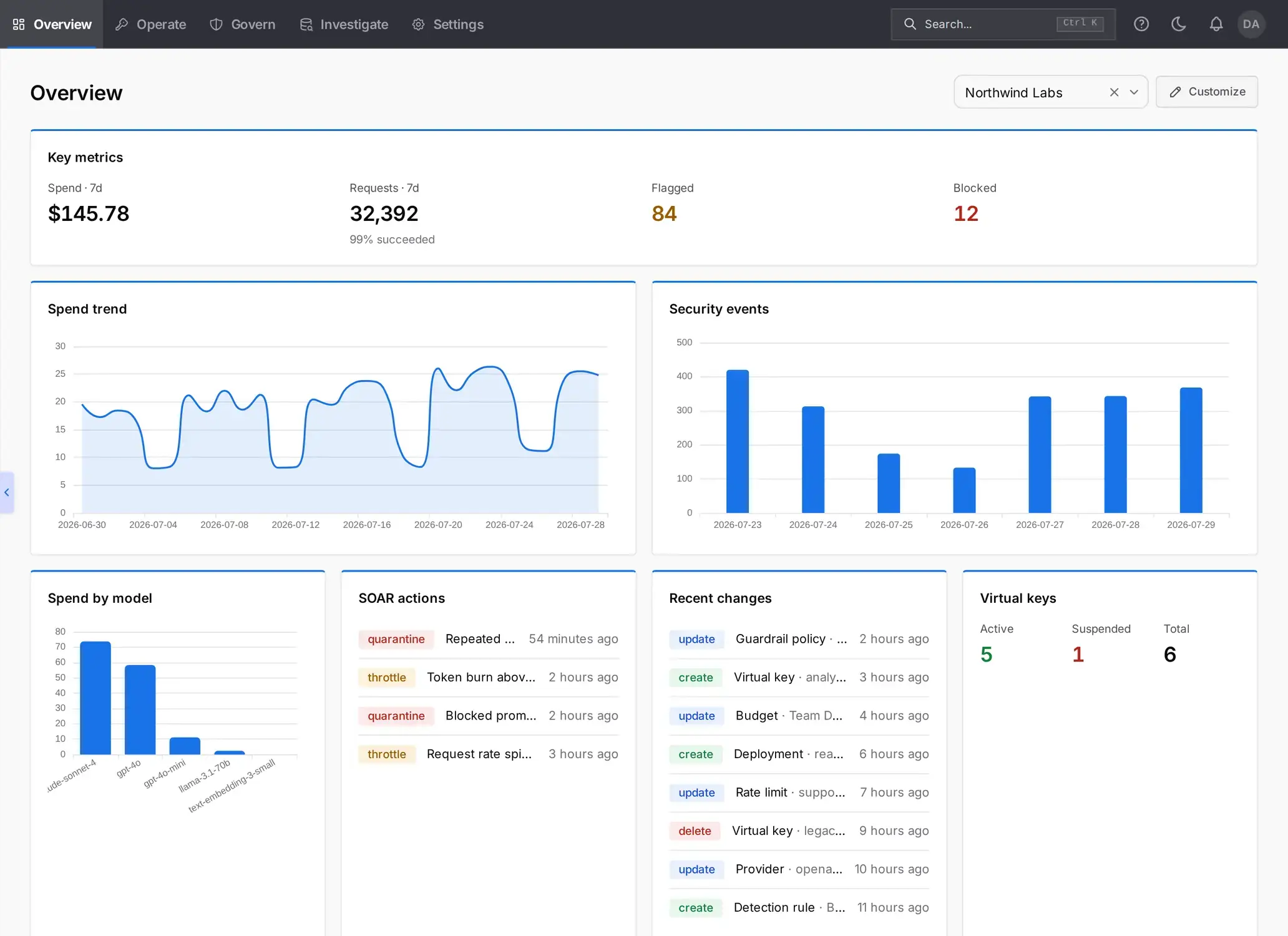
Console overview from a demonstration deployment carrying synthetic traffic.
Administration, investigation, and evidence in one dashboard.
Manage keys, providers, budgets, and guardrail policy, then search the governed activity behind every decision — without leaving your own network.
Recorded against a demonstration deployment with synthetic traffic.
Issue and revoke virtual keys, register providers and model aliases, rotate vendor credentials, and set routing.
Define guardrail categories, detectors, and per-direction policy; set budgets and rate limits at any scope.
Search the audit trail, review guardrail findings and detections, and inspect the decision behind any call.
Track spend by model and over time, read request-density heatmaps, and export scheduled usage and security reports.
One governed layer between agents and model providers.
Applications authenticate with scoped, revocable virtual keys while provider credentials stay encrypted inside your environment. No reusable vendor secret needs to live in agent code.
Every model request is evaluated against identity, team, model, budget, rate, and guardrail policy before it is forwarded to a configured provider.
Security and platform teams get one operational record across model requests, guardrail decisions, usage, configured cost, and outcomes.
Agents & applications

Agent Access Manager
Model providers
Access, policy, routing, and evidence in one platform.
Agent Access Manager brings identity context, credential protection, routing, guardrails, cost control, and security records into the same request path.
Issue revocable, expiring virtual keys for applications, agents, teams, and projects without distributing provider credentials.
Keep provider credentials AES-256-GCM encrypted inside the gateway and inject them only when forwarding a governed request.
Map model aliases to several deployments, then load-balance with health-aware routing and automatic fallback across vendors.
Inspect requests and responses for PII, secrets, and patterns with allow, flag, redact, or block actions — streaming included.
Apply spend and token budgets plus RPM/TPM limits across organizations, teams, projects, and individual keys.
Cap an expensive vendor per deployment and let a governed alias fail over to a cheaper backend instead of failing the call.
Search model-call and guardrail events, run Sigma detections and behavioral analytics, and apply reversible containment.
Investigate governed activity with the applicable identity, provider, model, token usage, configured cost, and outcome.
Bring providers and agent frameworks behind one governed endpoint.
Connect supported cloud and self-hosted models, then point compatible SDKs, frameworks, coding agents, and internal applications at Agent Access Manager.
Model providers
Route through customer-managed provider connections.
Centralize provider configuration and model aliases while applications use scoped virtual keys instead of reusable vendor credentials.
 OpenAI
 Anthropic
 Azure OpenAI
 AWS Bedrock
 Google Gemini
 Vertex AI
 Cohere
 Mistral AI
 Groq
Groq Ollama
 Meta Llama
 IBM watsonx
 NVIDIA
 Databricks
 DeepSeek
Additional providers connect through any supported OpenAI-compatible endpoint.
SDKs and frameworks
Keep the development tools your teams already use.
In most integrations, an application changes the base URL and swaps the provider key for an Agent Access Manager virtual key.
 LangChain
 LangGraph
 LlamaIndex
 DSPy
DSPy Vercel AI SDK
 LiteLLM
 Semantic Kernel
 OpenAI SDK
 CrewAI
Guides are available for OpenAI, Anthropic, Gemini, Vertex AI, LangChain, and supported self-hosted models.
Common questions about governing AI access.
How Agent Access Manager governs application and agent access to models in customer-managed environments.
What is Agent Access Manager?
Agent Access Manager is a self-hosted AI gateway and governance layer that sits between your applications and your LLM vendors. Applications get a single OpenAI-compatible endpoint and revocable virtual keys; the platform routes each call to the configured provider, enforces budgets, rate limits, and guardrails at runtime, and records governed activity in a searchable audit trail. It deploys in your own environment with Docker Compose or Kubernetes.
How do AI agents access models without seeing our provider API keys?
Provider credentials are registered once by administrators and kept AES-256-GCM encrypted inside the gateway; they are never returned to clients. Each application, team, or agent instead receives a scoped virtual key that is revocable, can expire, and carries its own budgets, rate limits, and guardrail policy. Revoking a virtual key cuts off that consumer without rotating the underlying provider credential.
Which LLM providers and SDKs does the gateway support?
The gateway exposes OpenAI-compatible chat, embeddings, responses, messages, and models APIs, with provider adapters for OpenAI-compatible services, Anthropic, Gemini, and Vertex AI, plus self-hosted backends such as Ollama, vLLM, and LiteLLM. Existing applications built on the OpenAI SDK, Anthropic SDK, LangChain, or coding agents like Claude Code and Codex connect by changing the base URL and key — no application rewrite.
Can Agent Access Manager run fully on-premises or air-gapped?
Yes. Agent Access Manager is customer-managed software deployed in your own environment — single-host Docker Compose or multi-replica Kubernetes with Helm — and supports offline installation. Prompts, responses, credentials, and audit data stay inside your infrastructure, and provider usage runs through your own vendor accounts.
How does Agent Access Manager handle model-generated tool calls?
The current gateway preserves or translates supported tool and function-call fields and provides tool-call argument screening through configured response guardrails using flag or block actions. It does not currently provide an MCP server registry or per-tool execution permissions. Tool execution must be authorized and audited by the agent runtime, tool service, or a separate tool gateway.
How does it help with SOC 2 or ISO 27001 audit evidence?
Every governed request is recorded with the applicable identity, policy decision, provider, model, token usage, cost, and outcome. Audit trails are searchable, and scheduled usage and security reports export in PDF, CSV, JSON, and HTML. Built-in SIEM search, Sigma detections, behavioral analytics, and SOAR containment support security operations on the same event stream.
See your first governed model call in under an hour.
Talk to the engineers who build Agent Access Manager. We will map your providers, agents, deployment environment, and governance requirements to a practical control architecture.
We typically respond within one business day.